CARBON AND ITS COMPOUNDS
Bonding In Carbon The Covalent Bond
The atomic number of carbon is 6 it has four electron in its outermost shell and needs to gain or lose four electron to achieve noble gas configuration
CASE 1
If carbon gain four electrons forming C4 anion but it would be difficult for the nucleus with 6 Proton to hold on 10 electron that is 4 extra electron
CASE 2
If carbon lose 4 electrons to form C4 cation but it would require a large amount of energy. If we remove four electron it will leave behind a carbon cation with 6 proton in its nucleus holding onto just two electron
Carbonn overcome this problem by sharing its valence electron with other atom of carbon or atom of other element
ELECTRON DOT STRUCTURE OF AMMONIA
METHANE
- Methane is widely used as a fuel
- It is a measure component of biogas
- Major component of CNG compressed natural gas
- It is simplest hydrocarbon formed by carbon
STRUCTURE
COVALENT BOND
Bond formed by the sharing of an electron pair with two other atoms are known as covalent bond
Question :- why covalent bond compound have low melting and boiling point ?
Answer:-covalent bond strong within the molecule but internal molecular forces are small this give rise to low melting and boiling point of the compound
Question :- why covalent compound are poor conductor of electricity ?
Answer:-Because electron are share between atoms and no charged particles are found that is why covalent compound are poor conductor of electricity
VERSATILE NATURE OF CARBON
Carbon has a unique ability to form Bond with other atom of carbon giving rise to formation of large number of molecules this property is called catenation
CATENATION
The unique property of carbon to form large number of bonds (single, double or triple) with itself or other atoms
SATURATED COMPOUNDS AND UNSATURATED COMPOUNDS
Saturated Compounds
compounds of carbon which are linked buy only single bond between the carbon are called saturated compounds
Unsaturated Compound
compound of carbon having double or triple bond between carbon atoms
carbon is capable of form bonds with four other atoms of carbon atom or other monovalent atom
CHAIN,BRANCHES AND RING
SKELETON OF CARBON CHAIN
C-C-C-C
FULLFILL VALENCY
SKELETON OF CARBON CHAIN WITH BRANCH
FULL FILL VALENCY
RINGS
BENZENE RING
Structural Isomers
those compounds which have same molecular formula but different structure are called isomers
NOMENCLATURE OF HYDROCARBONS
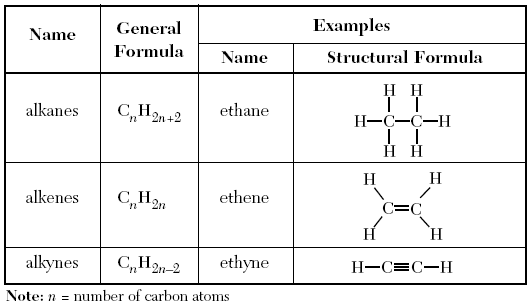
GENERAL FORMULA OF ALAKNE ALKENE ALKYNE
SUFIX/PREFIX USED IN NAMING CARBON COMPOUNDS
Chemical Properties Of Carbon Compounds
Combustion
- carbon and its allotropic form burns in oxygen to give carbon dioxide along with release of heat and light
- Saturated hydrocarbon give clear flame
- Unsaturated carbon compounds give yellow flame with lot of black smoke
C+O2------>CO2 + HEAT + LIGHT
CH4+O2------->CO2+H2O+HEAT + LIGHT
CH3CH2OH+O2------>CO2+H2O+HEAT + LIGHT
why cooking vessel getting black at the bottom while cooking ?
The gas like kerosene which are used in stove used at home has inlet for Air so that a sufficiently oxygen rich mixture is burnt to give a clear blue flame when we put vessel on the stove the air holes are blocked and fuel is getting wasted this result in incomplete combustion and result in shoot deposit.
Oxidation
- carbon compound can be easily oxidized on combustion
CH3CH2OH(ethanol)--------KmNO4+heat----->CH3OOH(ethanoic acid)
- substance which capable of adding oxygen to other are known as oxidising agent
- oxidizing agent are used in above chemical reaction
ALKALINE KMNO4--->potassium permagnette
ACIDIFIED K2Cr2O7-------->potassium dichromate
Addition Reaction
Unsaturated hydrocarbon add hydrogen in the presence of catalyst Palladium or nickel to form saturated hydrocarbon known as addition reaction
R---->ALKYL GROUP( -CH2 , -CH2CH3 )
Catalyst
those substance that cause a reaction to occur or proceed at a different rate without going into reaction itself are known as catalyst
use
the reaction is commonly used in hydrogenation of vegetable oil using a Nickel catalyst
Vegetable Oil
- unsaturated carbon chain for cooking
- animal fat saturated carbon chain saturated fatty acid harmful for health
Substitution Reaction
in the presence of Sunlight chlorine is added to hydrocarbon in a very fast reaction chlorine replace the hydrogen atoms one by one it is called substitution
Ethanol
- ethanol is liquid at room temperature
- it is known as alcohol
- it is active ingredient of all alcoholic drinks
- it is a good solvent
- it is used in medicine cough syrups
- ethanol is highly soluble in water
- health problem intake of small quantity of ethanol can be Lethal if taken in large amount
Reaction of Ethanol
2Na+2CH3CH2OH---------2CH3CH2ONa+H2
CH3CH2ONa( Sodium ethoxide )
CH3CH2ONH------conc H2SO4------>CH2=CH2+H2O
Ethanoic Acid
- it is known as acetic acid
- 5 to 8% of solution of Acetic Acid in water is called vinegar and used widely as preservative in pickles
- melting point to 240k it often freezes during winter in cold climate call glyceryl acetic acid
- Ester are sweet smelling substance used in making perfume and as a flowering substances
Saponification
STEP 1: CH3COOC2H5--------NaOH(base)-------->C2H5OH+CH3COOH
STEP 2: NaOH+CH3COOH---------->CH3COONa+H2O
Reaction with Carbonate and Hydrocarbonate
2CH3COOH+Na2CO3------>2CH3COONa+H2O+CO2
CH3COOH+NaHCO3------->CH3COONa+H2O+CO2
Soaps And Detergent
SOAP
|
DETERGENT
|
The Molecule Of Soaps Are Sodium Or Potassium Salt Of Long Chain Of Carboxylic Acid
|
Detergent are Ammonium Sulphate Salt Of Long Chain Of Carboxylic Acid
|
They Did Not Give Leather In Hard Water
|
They Give Leather In Hard Water
|
Used In Making Bathing Soap
|
Used In Samples And Product For Cleaning Clothes
|
Cleansing Action Of Soap
the ionic end of soap dissolves in water while the carbon chain dissolve in oil. The soap molecule thus form a structure called micelle where one end of the molecule is towards the oil droplets while the ionic end faces outside. This forms an emulsion in water. The soap micelle thus help in dissolving the dirt in water and we can wash our clothes clean.